If someone were to ask me to summarise what I felt FaithAction had managed to achieve in the past two decades, I’d be rather tempted to say that we’ve managed to move the needle.
Maybe that does not sound like much by itself, but it’s the culmination of many small yet significant changes that we’ve been a part of over these past two decades.
Now, you may, of course, be asking just what needle it is that I’m referring to.
When LifeLine Projects first began back in 2000, it was born out of the vision and initiative of a group of members of from a local church. This was at a time when both the local and national attitude was less conducive to faith-based activity. Faith-based organisations and similar groups would often be viewed with suspicion over the notion of ulterior motives, and the quality of their work was seen to be lacking. So, in those early days, we made a key decision—to become known, not for whence we came, but for what we’re able to achieve.
With the rapid growth of LifeLine Projects, it soon came to be that places of worship and faith communities were knocking on our door, wanting to find out how we had been so successful at developing ourselves—particularly as, at that time, we were focused on delivering a range of public service contracts to a high standard.
As a result, LifeLine was giving a lot of time, advice, and organisational mentoring to these groups—that’s when we realised it would be extremely helpful to form some kind of network to help give voice to this particular part of civil society, as well as to advocate for faith-based activity as a whole in the public square.
This leads us to 2006—FaithAction was formed in partnership with three bodies: the Muslim-led Faith Regeneration Foundation, the network of churches known as Faith Works, and LifeLine Projects itself as the lead organisation due to its experience in public service delivery.
A lot has certainly happened since 2006—and many lessons have been learned—but it’s time to return to the notion of moving the needle.
Initially, a lot of FaithAction’s time was dedicated to advocating for the role of faith-based activity in public service delivery. Faith groups have always held a unique position within certain communities and sections of society, many of which can sometimes be neglected by more traditional public services. And we often hear that faith groups are the first place families turn to when they need support, a clear reflection of the trust and proximity that they’ve fostered over many years.
For those in need, the practical support offered by faith communities is a constant—faith is the first in and the last out.
In helping other organisations navigate public service delivery, we have often had to take on the role of translator, or perhaps interpreter—to aid those of faith understand the jargon of the public sector, and to help officials understand what faith groups can offer in ‘real’ terms. And, to this end, we have shared best practice and enabled organisations to professionalise their offerings without losing this unique edge they have to reach straight to some of the most marginalised in our society.
In many cases, this means being present for families in very practical ways, offering support that is trusted, local, and most importantly, consistent. And it’s through this everyday support that the biggest differences are made.
Our journey
2009
FaithAction becomes a founding member of the Department of Health’s Strategic Partner Programme, later renamed the Health and Wellbeing Alliance.
We found that civil servants with the Department held a significant vision that recognised faith not just as a potential delivery partner, but as a significant voice for many sections of the country. With faith being considered a vital part, this gave us greater scope to engage with the faith sector on health issues too.
2012
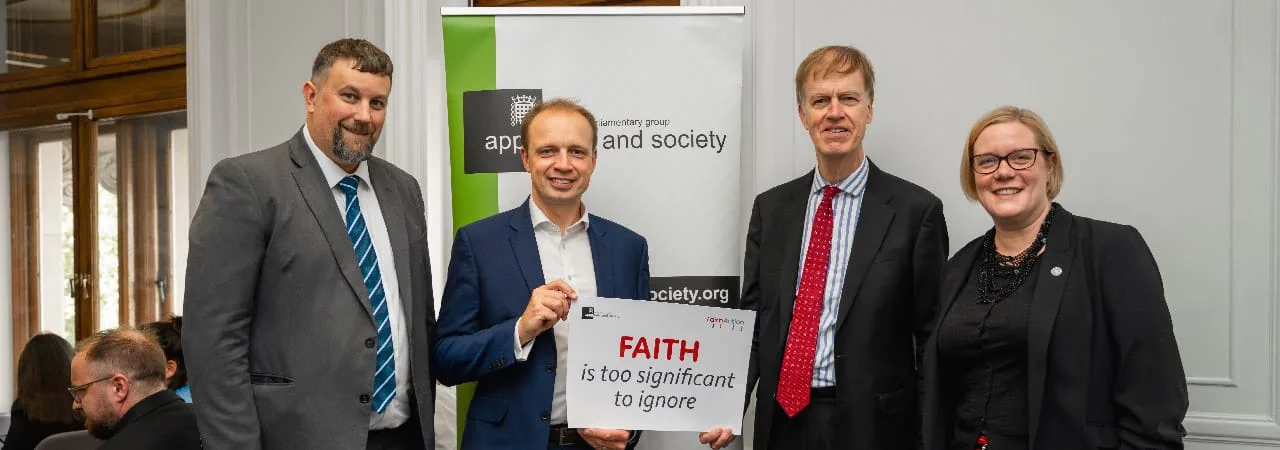
Working with Sir Stephen Timms MP, and supported by Gary Streeter MP and Tim Farron MP, we helped form the All-Party Parliamentary Group (APPG) on Faith and Society, for which we became the secretariat. This was a key milestone, with many MPs and Lords recognising they can help to harness the potential of faith-based activity across the UK.
2013
Inspired by the varied areas of work carried out by Lifeline Projects, we too wanted to make a direct difference, focusing on the subject of belonging, cohesion, and integration. Initially funded by the then-Department for Communities and Local Government, we developed a programme for teaching everyday English in an informal setting while also helping to build confidence and connection in its participants that could easily be delivered by faith and community groups.
This was built on the “Creative English” concept, originally developed by Dr. Anne Smith who has been a key member of the FaithAction team ever since. And what started as a small project has now become a significant franchise, with faith groups delivering Creative English all over the country and over 25,000 learners benefitting from this approach to date!
2014
2020
In a time marked by the COVID pandemic, the Faith Covenant particularly came into its own. The relationships that had been built—both between different faith groups and between faith and local government—were heavily utilised as social infrastructure during the pandemic. Faith communities were relied upon to act as vaccination centres, to help disseminate health information, and to provide practical support such as delivering groceries or medication to those in lockdown.
For many families, these local faith networks became a vital source of practical and emotional support during an incredibly uncertain time. This support was often what helped people get through each day.
2022—
The pandemic brought to light significant health inequalities within certain communities, those that were difficult to reach through traditional health interventions. As a result, we began working with select local authorities, helping them utilise their faith groups to reach into these communities and deliver projects to their support the health needs.
In 2022, we worked with Tower Hamlets Council in delivering a range of health-focused projects, which was extended in 2023 with a specific focus on Black African churches.
Since then, we’ve also partnered with Birmingham City Council to identify the health needs of and then engage with the Sikh and Christian communities and with Barking and Dagenham Council to engage local faith groups with supporting their communities with cost of living and public health issues.
Building back better—our contribution beyond COVID
In the aftermath of the pandemic, the swift and far-reaching response to the crisis made by faith communities was plain to see. The needle moved further. And I feel it’s fair to say that there are few voices remaining that say that faith shouldn’t have a role in broader society.
We were already aware of the significant inroads made into this new approach. Faith groups are supporting those who struggle hardest to find employment. Faith groups are being foster families. Faith groups are providing hospital transport, mentoring young people, and running food banks. Faith is a great motivator, and faith has drawn people together to make a difference for others for as long as human history.
So, it should be no surprise that when a crisis hits, central government, local government, the NHS, the Police, the Fire Service all turn to faith for assistance. During the pandemic, some even referred to faith as “the fourth emergency service”. In certain circumstances, this seemed to be a most fitting label.
Perhaps then, the challenge for us now is not to keep ‘moving the needle’, but to establish that faith is for more than just times of crisis, to truly entrench it as a significant part of community services.
And more than that, faith should always play a part in guiding our future as a society—whether it’s contributing to the design of new housing estates, shaping the social architecture around health and social care, or offering support of our families and children.
This includes ensuring that people are supported early and proactively—not only when challenges are at their most severe, but through everyday relationships and trusted local networks.