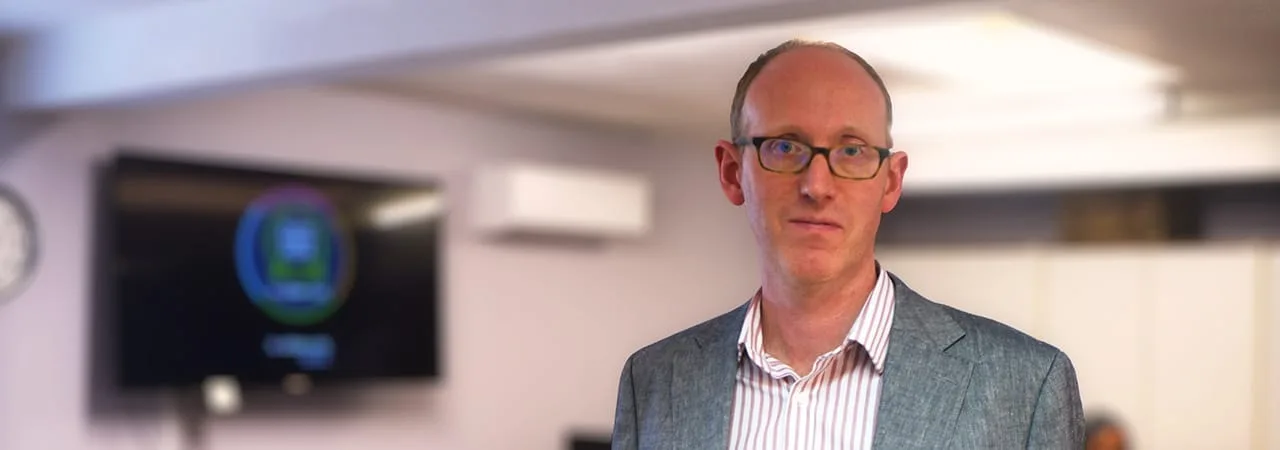
This month, we’re talking with David, who has supported our Business Development team for the past five years, and has recently become part of our Senior Management Team where he’s helping to shape LifeLine’s future.
Can you tell us a bit about yourself?
I was born in Plymouth but, as a young child, my family moved to West Yorkshire. I grew up in a small village between Leeds and Humberside. It was a beautiful place where everyone knew each other, and the Pennines were only a short distance away
My dad, who was an architect originally from London, and my mum, who taught English Literature and is from Yorkshire, created a home that was always full of books, a mix of classical literature and planning manuals. Growing up in a family rooted in two very different parts of the country gave me an early appreciation of different places, cultures, and ways of life. It was a typical nuclear family. I had one sister, who has also since settled in London.
My dad’s profession as an architect had a strong influence on me from an early age. I spent a lot of time at his office watching and observing his building projects and how they came together which sparked my interest in buildings and how places are shaped. That early exposure also encouraged my interest in travelling and experiencing new environments.
This led me to study Urban Studies at York University, exploring how cities develop and function and how places are organised. After university, I took a role at Leeds City Council for a couple of years, which gave me valuable practical experience. I then moved to London to complete my Masters. I’ve stayed here ever since.
What does your job as Business Development Manager involve?
It’s about turning LifeLine’s vision and strategy into on-the-ground programmes and services by securing funding and working with commissioners. It’s a role that is always challenging, but it can also be very rewarding.
Right now, it’s difficult for any organisation to focus on growth because of the current economic climate. So, our priority is to strengthen our relationships with our existing funders and commissioners, keep our current projects going where possible, and make sure our work supports new national and local policy priorities as they emerge.
On a personal level, I think good judgement, professionalism, and the ability to combine logical thinking with creativity are all essential for success in business development within the non-profit sector.
How long have you been involved in business development?
I’ve worked in these kind of roles on and off for almost 20 years now. I can’t say it was something I specifically set out to do, but it suited my skills and the way I naturally think.
I tend to look at the bigger picture and take a longer-term view when it comes to planning and decision-making, which fits well with a strategic role. I suppose that’s why I’ve ended up in a senior leadership position. It wasn’t something I deliberately pursued—I just gradually found myself moving in that direction.
I wouldn’t say there was a specific moment that inspired me to move into business development within the charity sector. It was more of a natural progression from the local government work I had been involved in, as there are a lot of similarities between the two. It felt like a comfortable move because I found myself working with similar types of people and in a familiar environment.
What do you find most rewarding about your role?
Perhaps the most rewarding part is seeing projects that have been planned for a long time, or areas of policy we’ve worked on, become a reality and make a difference in the real world.
But also, one of the things I enjoy most is mentoring people, like our Bid Writer Jaden, and helping them develop their skills so we can work better as a team.
Throughout your career, you meet people who inspire you through their knowledge, experience, and leadership. When you start building and leading your own team, you naturally carry forward the lessons and qualities you’ve learned from those who supported and mentored you.
What gives you hope for the future of LifeLine?
This is a challenging time because I see the financial pressures facing government and public services every day, and I don’t think that situation will change anytime soon. For us, it will be important to stay connected to changes in community policy and the wider plans for economic growth, as well as making sure our work fits with these priorities will be a key focus over the next five years.
What would you want others to better understand about LifeLine?
If the government and major funders want to make a real difference in local communities, they need to work closely with organisations on the ground. These local groups understand the everyday challenges people face in a way that statistics and reports often cannot show.
What was a moment in your life that you're especially proud of?
This comes from my academic work, particularly when I’ve presented research at conferences and received positive feedback. I’ve had the opportunity to speak around the world, and it’s always rewarding when people tell me that my ideas have influenced or inspired their own work.
Have you had any particularly challenging moments that you've learned from?
You’re always learning. In business development, you have to be resilient because there are often just as many unsuccessful proposals as successful ones. The key lesson is not to take rejection personally, learn from it, and keep moving forward. The aim is to make small improvements over time. Setbacks are part of the process, but with funding bids, you also have to be aware that deadlines are critical and there’s no room for being late.
What is something about you that most people at work might not know?
I like going to the theatre. I don’t go all the time, but I have seen lots and lots of plays over the years.