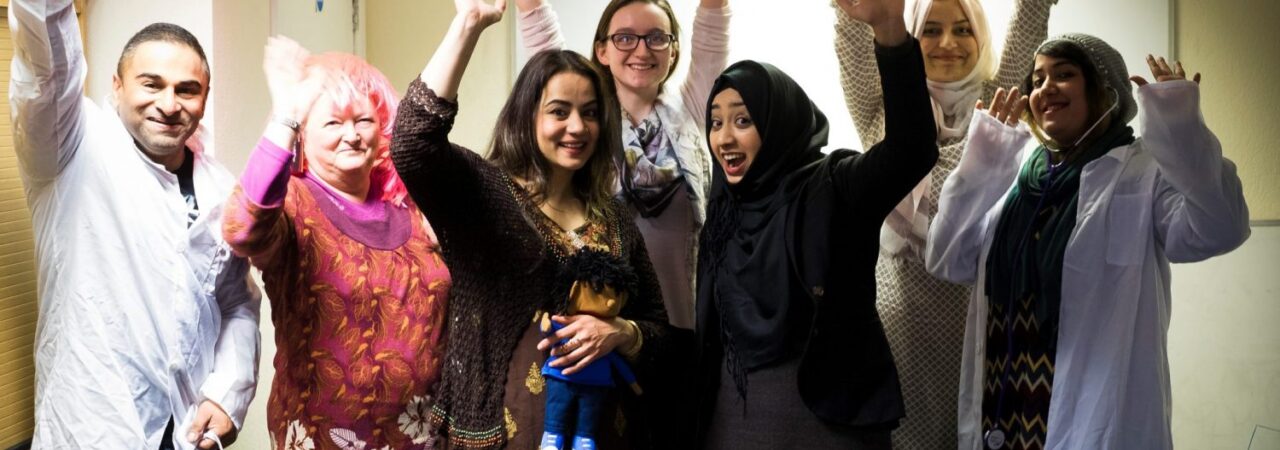
Creative English—a programme developed by our FaithAction team—helps to teach simple conversational English through fun and games and an ongoing roleplay story inspired by soap operas.
If you would like to know more about Creative English and how the programme helps people build confidence, connection and independence, please visit creative-english.org.uk for further information.
When I first met Mariam† in our Creative English Parent and Child class in 2009, she was quiet and careful in the way she moved. She often sat near the back of the room, her arms wrapped protectively around her child. Her eyes looked tired, not just from lack of sleep but from carrying a heavy load on her own.
She later told me how difficult life had been at that time. “We had nothing,” she said. “Just three plastic plates and three spoons. I cooked rice once a day for us. That was all we had.” It was clear that speaking about that period still touched something deep.
Work had been a struggle. “I did not know how anything worked here,” she explained. “I tried to find a job but did not know where to go. I was tricked online and lost money. Then I found work for one pound an hour. I had no one to look after my children. Everything felt so hard.”
When she later told me this, I was deeply shocked. It was clear she had been exploited, and I told her that if anything like that ever happened again, I’d help her challenge it without hesitation.
Language was one of her biggest barriers. “Without English, you cannot be independent,” she said. “You cannot look after yourself or your children properly.”
In our Creative English sessions, Mariam found a safe space to learn. She listened closely and repeated each phrase with great care. And she asked many questions, wanting to understand every detail. Talking to others in the group—many of whom had been through similar things—helped her more than any leaflet or website could.
During those early weeks, she made a friend who would become a constant support. “A good friend is like a therapist when life is tough,” she said. “She helped me stay strong.” Their friendship grew over time, and they still stay in touch today.
As her English improved, something in her changed too. She began to lift her head when she spoke. She smiled more readily. Her voice grew steadier. She no longer sat at the back of the room but joined in the activities with confidence. Watching her transform was one of the greatest joys of my work.
In time, Mariam found work as a receptionist. “I felt so proud answering the phone,” she told me. From there she became a healthcare assistant and later secured a job in a hospital. This meant she was able to buy a car, which made travelling around much easier. “I felt free for the first time,” she said.
She also worked hard to rebuild her credit score. “I never thought I could own a home,” she said. But, step by step, she made progress. The day she told me she had become a homeowner, she could hardly contain her joy. “I can paint the walls. I can put up pictures. It is really my home,” she said, smiling wide.
Looking back, she reflects on how far she has come. “If I saw myself now, at the start, I would be surprised,” she said. “I am a strong woman. I know I can deal with difficult things. My parents would be so proud.”
Walking alongside Mariam on her journey has been a privilege. What began as a classroom connection slowly became a friendship built on trust, hope and many shared moments.
Her story is a reminder of how much people can grow when they feel seen and supported.
Dr Anne Smith PhD
Creative English Founder and Lead Trainer